
When Your Kids Don't Want What You Came Here For
There's a moment Dr. Alejandra Carvallo mentions in passing that stopped us cold...
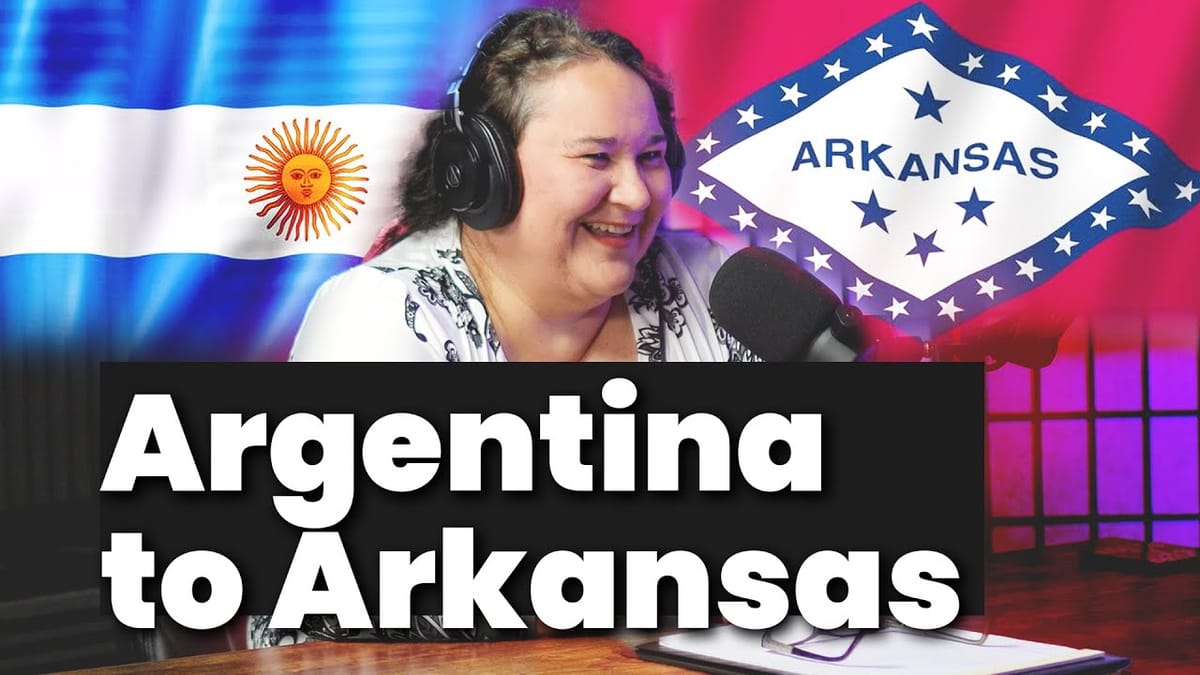
There's a moment Dr. Alejandra Carvallo mentions in passing that stopped me cold.
She's been teaching Spanish at Arkansas Tech University for fifteen years. She's worked with hundreds of local Hispanic students and their families. And lately, she's noticed something shifting.
"I used to see the parents saying, 'Oh, I want my son to go to college,'" she told me recently. "Now it's like I'm seeing more of, 'Okay, he wants to do this, or he doesn't want to study, or he gets married, and this and that.' The priorities are changing a bit."
It's a quiet observation. But it points to something happening right now in Russellville that deserves our attention: What happens when the second generation doesn't share the educational dreams of the first?
The Scholarship Gap We're Not Talking About
According to a 2023 report from the Pew Research Center, Hispanic enrollment in four-year colleges has reached record highs nationally. But the same report found that Latino students are significantly more likely than their white peers to cite cost as a major factor in their college decisions—and more likely to forgo college entirely for financial reasons.
Here's what makes that statistic particularly painful: many of these families *do* have money. They're just spending it differently.
Dr. Carvallo doesn't mince words about this. "For the quinceañera, you don't even question it. Put $20,000, $30,000, and sometimes for education, we think about it."
She's not criticizing quinceañeras. She's asking us to examine our priorities with clear eyes.
The $700 Car Payment That Cost Everything
One story haunts her still.
A promising young woman, studying nursing. Scholarships lined up. Mentors invested. A clear path forward. Then she bought a car—a brand-new model with a $700 monthly payment.
To cover it, she started working more hours at a nursing home. Then more hours. The scholarship required maintaining certain grades and credit hours. She couldn't do both.
"I've already lost it," Dr. Carvallo said, her voice dropping. "She studied for two years. She had scholarships and support from a lot of people. And her decision was to pay for that car."
The father wouldn't let her sell it. Today, that young woman is likely still working at that nursing home, mid-career, mid-dream, stuck.
"A lot of parents would like to go back," Dr. Carvallo said. "I'm seeing mothers returning after raising their children. She says, 'Okay, this is my moment.' But sometimes you have to push the kids a little harder."
The Argentina-to-Arkansas Education Philosophy
Dr. Carvallo's own story reads like a master class in strategic life decisions. She arrived in the United States at 25, already an English teacher in Argentina, but determined to master North American English. She came on a cultural exchange to Iowa, lived with an American family, taught at a high school, then pivoted to university teaching.
She completed both her master's degree—at an Ivy League school, no less—and her PhD essentially for free through teaching assistant-ships. "Basically I did it for free. They paid me, medical insurance, everything."
Her husband is also a professor. For six years, they lived in three different houses while he worked in South Carolina and she taught at Tech, meeting on weekends when they could manage the fourteen-hour drive. When he finally got a position closer to home—at the University of Arkansas at Little Rock—it still meant three hours of daily commuting.
Why endure all that? Their daughter.
From the day she was born, every birthday check from grandparents, every monetary gift, went into a special education savings account. Not a regular savings account—a specific college fund that works like a retirement account, growing in the market. Dr. Carvallo started contributing $100 per paycheck, then increased it to $250 as college approached.
The result? Their daughter is now in her third year of civil engineering at a private university out of state—her choice—with her entire education covered. No loans. No debt.
"In our family the priority is education," Dr. Carvallo said simply.
What Tech Actually Costs (And What It Doesn't)
Here's something most Russellville families don't realize: students at Arkansas Tech can graduate without paying a penny out of pocket. Some even make money.
"There are boys who don't pay a penny, in fact they make money," Dr. Carvallo explained. "Why? Because they have scholarships, they study hard."
The sticker price—roughly $8,000 per semester for in-state students—looks daunting. But that's before scholarships, before AP credits, before federal aid. A student who takes four AP classes in high school and scores well enough gets a free semester. Students who study through the summer can finish in three years instead of four.
According to data from the National Center for Education Statistics, the average student loan debt for bachelor's degree recipients at public four-year institutions was $28,950 in 2022. But at Arkansas Tech, students who live at home save approximately $16,000 per year in housing costs alone compared to universities in Conway or Fayetteville.
"I understand the boys who want to go away," Dr. Carvallo said. "But sometimes you have to be practical in life. Don't get into debt because you don't want to live with your parents."
She recalls working with one student who was determined to attend a university in southern Arkansas because her friend was going. When they sat down together to review the scholarship offer, Dr. Carvallo asked a simple question: "Did you realize that this is for the semester and not for the year?"
The girl froze.
"You have to know how to read, miss," Dr. Carvallo told her. The counselor who had helped her hadn't caught it either. The student's parents were working two jobs to send their daughter to follow a friend to a school that would cost twice what they thought.
The Groups That Catch Students
Dr. Carvallo isn't just a professor. She's an advisor to three student organizations that function as safety nets and launching pads for local students.
She leads the Sigma Delta Pi chapter at Tech—the Spanish Honor Society for advanced students, which offers scholarships for study abroad and looks impressive on résumés. She also advises the local LULAC (League of United Latin American Citizens) chapter, which has become more than a campus club. They raise funds through tamale and pupusa sales, send the money to LULAC Nacional, which partners with corporations like Coca-Cola, Ford, and Google to match donations. A $1,000 fundraiser becomes $1,600 in scholarships.
But this year, Dr. Carvallo added a new requirement: to receive a LULAC scholarship, students must take at least one Spanish class.
"You don't appreciate your culture, you don't appreciate your Spanish, you don't ask for LULAC's scholarship," she said. "Very simple."
It's not punishment. It's strategy. Many second-generation students think they speak Spanish fluently because they grew up hearing it at home. Then they enter professional settings and realize they only know colloquial expressions—slang that doesn't work in medical interpretation, social work, or business settings.
"They all come and want to use the informal 'you,'" she said, referring to the informal Spanish address. "No, sir. In the profession you use the formal 'you,' because you don't know the person."
She teaches medical interpretation, preparing students to work as translators in healthcare settings. They don't just memorize words like *hígado* (liver) and *riñón* (kidney). They study diseases, systems, cultural communication differences, backup plans.
"When they already have previous knowledge, it's easier," she explained. "It's a deeper knowledge."
One of her former students, Mario, came to campus undecided about his major. Dr. Carvallo suggested he try medical interpretation while he figured things out. He ended up double-majoring in Spanish and political science. Through Tech's National Student Exchange program, he spent a semester at Queens College in New York, where he interned in a congressman's office. After graduation, he moved to New York to work for an immigrant advocacy organization.
"I don't see Mario coming back for a while," Dr. Carvallo said, smiling.
The Summer in Spain vs. The Car Payment
Dr. Carvallo's daughter didn't have a quinceañera. She didn't want one. Her grandparents threw a small party at a restaurant in Argentina. What she wanted instead was to study Italian in Italy.
The trip cost $4,000. A quinceañera would have cost around $20,000.
"Those options, those priorities," Dr. Carvallo said.
This summer, she's taking six Tech students to Spain for a study abroad program. They'll live with families and study the language intensively. One student is returning for her second trip—she went to Mexico with Dr. Carvallo during spring break, then to Spain for a month, then back to Spain for an entire semester. "At any moment I see her leaving again," Dr. Carvallo said.
These opportunities exist at Tech for students who know to look for them. The university has partnerships with institutions worldwide. Students can study abroad for as little as ten days or for an entire semester, often paying Tech tuition rates while living abroad. The National Student Exchange program lets juniors and seniors take specialized classes at other U.S. universities that Tech doesn't offer, paying Arkansas rates while studying in New York or California.
According to the Institute of International Education's 2023 Open Doors Report, students who study abroad have higher graduation rates and report greater career satisfaction. Yet Hispanic students remain significantly underrepresented in study abroad programs—just 11% of participants, despite making up 19% of college enrollment.
"If I were a student I would grab it in a second," Dr. Carvallo said of Tech's study abroad options.
When Parents Stop Pushing
The shift Dr. Carvallo is seeing isn't just about money. It's about resolve.
"In the past, parents came to this country just for that," she said. "To improve the educational possibilities of their children. And that's changing a little as a priority. The priority is to survive. But to survive richly."
She sees teenagers with the latest phones, driving new cars, working forty-hour weeks while trying to maintain full-time student status. She sees parents who are exhausted from their own work, who've decided not to "deal with the children," who've blurred the line between supporting their kids' autonomy and abandoning their responsibility to guide.
"We are parents, we are not friends," she said firmly. "You can have very open communication with your son. But tell him no when it is a no."
When her own daughter wanted to move to a more expensive dorm because she liked it better, the answer was no. "We are not going to work to earn $2,000 more per semester because you want a whim. That is a whim. It is not a necessity."
The money saved goes into an account for a future house down payment or other genuine need.
Research backs up this kind of parental involvement. A 2022 study from the University of California found that Latino students whose parents actively participated in college planning—not just emotionally supporting but strategically planning—were significantly more likely to enroll in four-year institutions and persist to graduation. The study emphasized that this involvement needed to be informed: parents needed to understand financial aid, application processes, and degree requirements.
That's where Dr. Carvallo comes in. Parents can bring their kids to campus for tours led by Spanish-speaking guides. They can email her with questions. The Tech website has a translation button that converts everything to Spanish. She helps families decode scholarship letters, compare actual costs, understand what "per semester" versus "per year" means.
"Some parents and some boys think that studying is impossible, that it is very expensive," she said. "The thing is that many of those boys don't pay a penny."
The Volunteer Work She Might Leave
Beyond campus, Dr. Carvallo serves on the board of Food for Kids, a nonprofit that provides weekend food backpacks to students and summer meal programs to River Valley families. She joined during COVID because she felt Hispanic families weren't aware of available resources.
"A Hispanic was missing in the group," she said.
But lately she's been considering stepping down. Between teaching, advising three student organizations, working as an assistant to the director of study abroad, spending ten days each summer as a table leader for Advanced Placement exams, taking students to Spain, and doing freelance interpretation and translation work, she feels stretched too thin.
"I feel like I'm failing my volunteer work there because I have not been able to give it the time it deserves," she said.
She's hoping another Hispanic community member—ideally a man, to balance the mostly female, mostly white board—will step up. "It is always good to have the posture of another person, of another group."
(If you're interested, you can reach Dr. Carvallo at acarvallo@atu.edu.)
What We Owe the Next Generation
Dr. Carvallo's dining room furniture is still her student set from graduate school. Her couch was replaced just three years ago. She and her husband drive practical cars and live below their means.
"We're looking for a way to do things more economically, to tie ourselves to the belts, until our daughter doesn't graduate from university," she said. "Until then we will continue to sacrifice."
That word—sacrifice—keeps coming up. It's unfashionable now. We're supposed to practice self-care, set boundaries, live our best lives. And those things matter. But Dr. Carvallo is talking about something different: the deliberate choice to delay gratification, to invest in the future, to say no to the $700 car payment so you can say yes to the study abroad program.
"We are teaching them to think, to make decisions," she said of her work at Tech. "Other things that have sometimes been forgotten in our society."
She knows students don't always appreciate the tough love in the moment. But years later, they come back. They send messages. They tell her she was right.
"I know that sometimes the kids don't appreciate it at the moment," she said. "But in the future they do."
The Question for Russellville
Here's what keeps me thinking: Dr. Carvallo is one person, teaching at one university, advising a few dozen students at a time. Imagine if every Hispanic professional in Russellville—the doctors, the business owners, the translators, the teachers—took on even a fraction of this mentoring role.
Imagine if every parent who worked two jobs to get here remembered *why* they came, and held that line with their teenagers who want the new truck.
Imagine if we built a culture where the question wasn't "Can we afford college?" but "Which scholarships are you applying for?"
The resources exist. Tech has the programs, the scholarships, the Spanish-speaking staff. LULAC has the funding. The knowledge is available.
What's missing is the push. The cultural reinforcement. The community agreement that education isn't just *a* priority—it's *the* priority.
You can hear the full conversation with Dr. Alejandra Carvallo on the ELEVA podcast:
And if you're a parent with a high school student, or a student trying to figure out if college is possible, send her an email. She'll answer. She always does.
Because in the end, that's what community looks like: people who came before reaching back, holding the door open, and refusing to let it close on the next generation—even when that generation doesn't yet understand what they're being offered.